
June 2026 (v7.0)
Tips and guidance to help the scorer and timekeeper for any level of the game.
PlayHQ Electronic Scoring Guide
Basketball England - How to Guide to Live Scoring
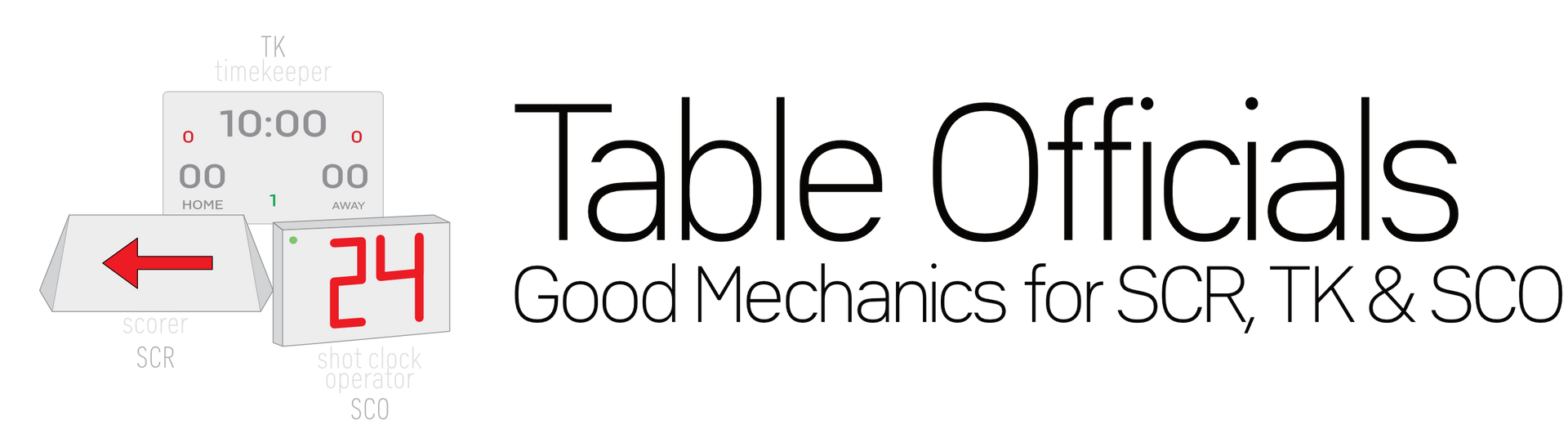
The scorer (SCR) is responsible for...
Recording of points, fouls and timeouts either elecgtronically or in the scorebook.
Administering the timeouts or subsitutes.
Use of the APA - alternate possession arrow.
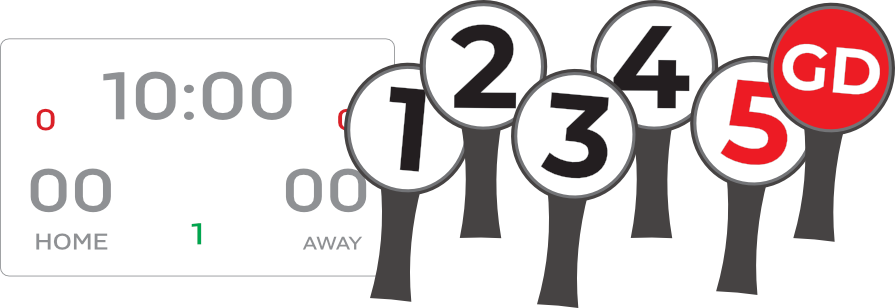
The timekeeper (TK) is responsible for...
Recording of points, fouls and timeouts on the game clock
Displaying the personal foul markers.
Use of the APA - alternate possession arrow.
The shot clock operator (SCO) is responsible for...
Displaying and running the offense shot clock.
Blanking and displaying the devise at the correct times.
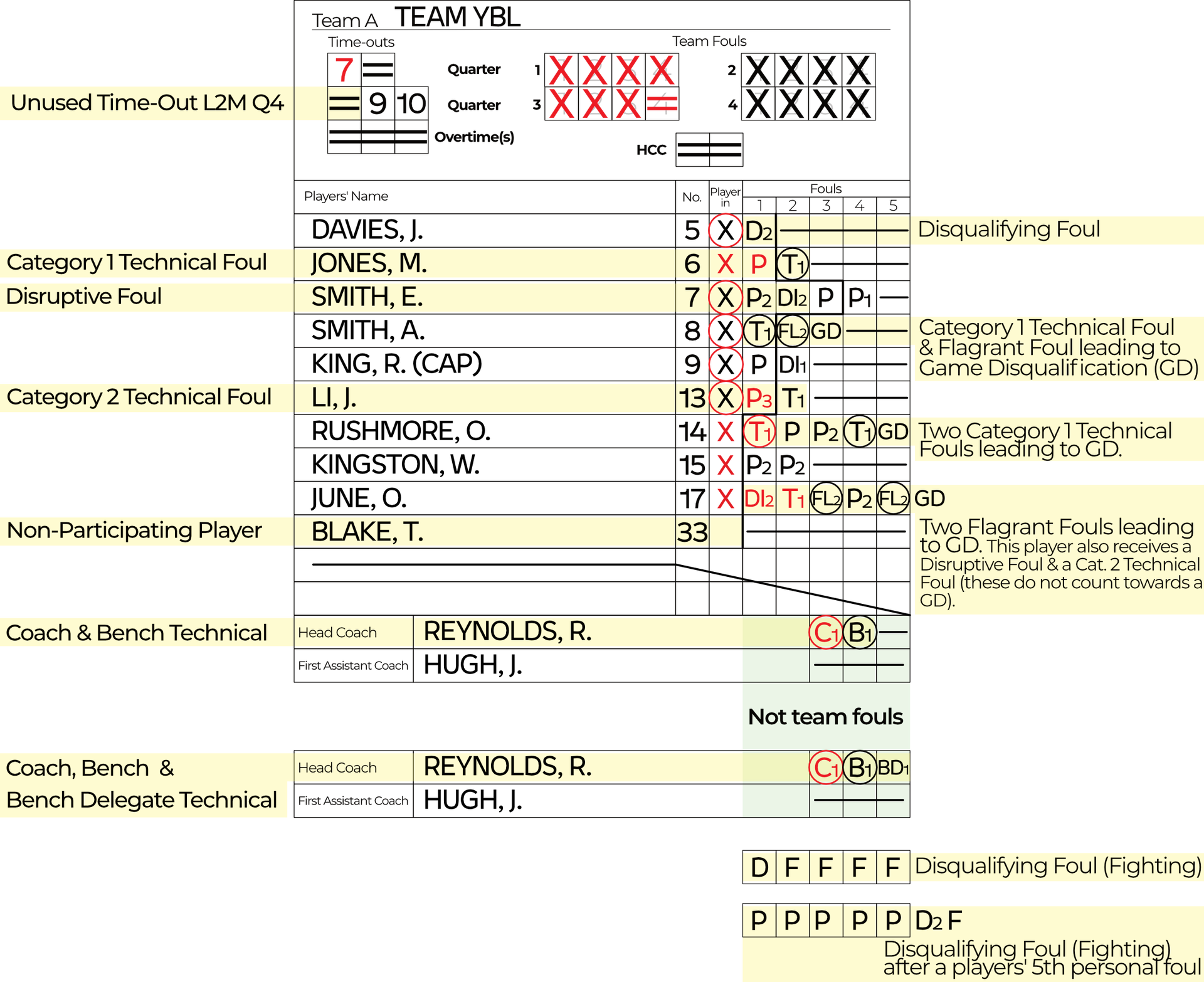
New Foul for Scoresheet - September 2026
General Administration - Before the Game
All writing should be in black or blue in CAPITAL letters


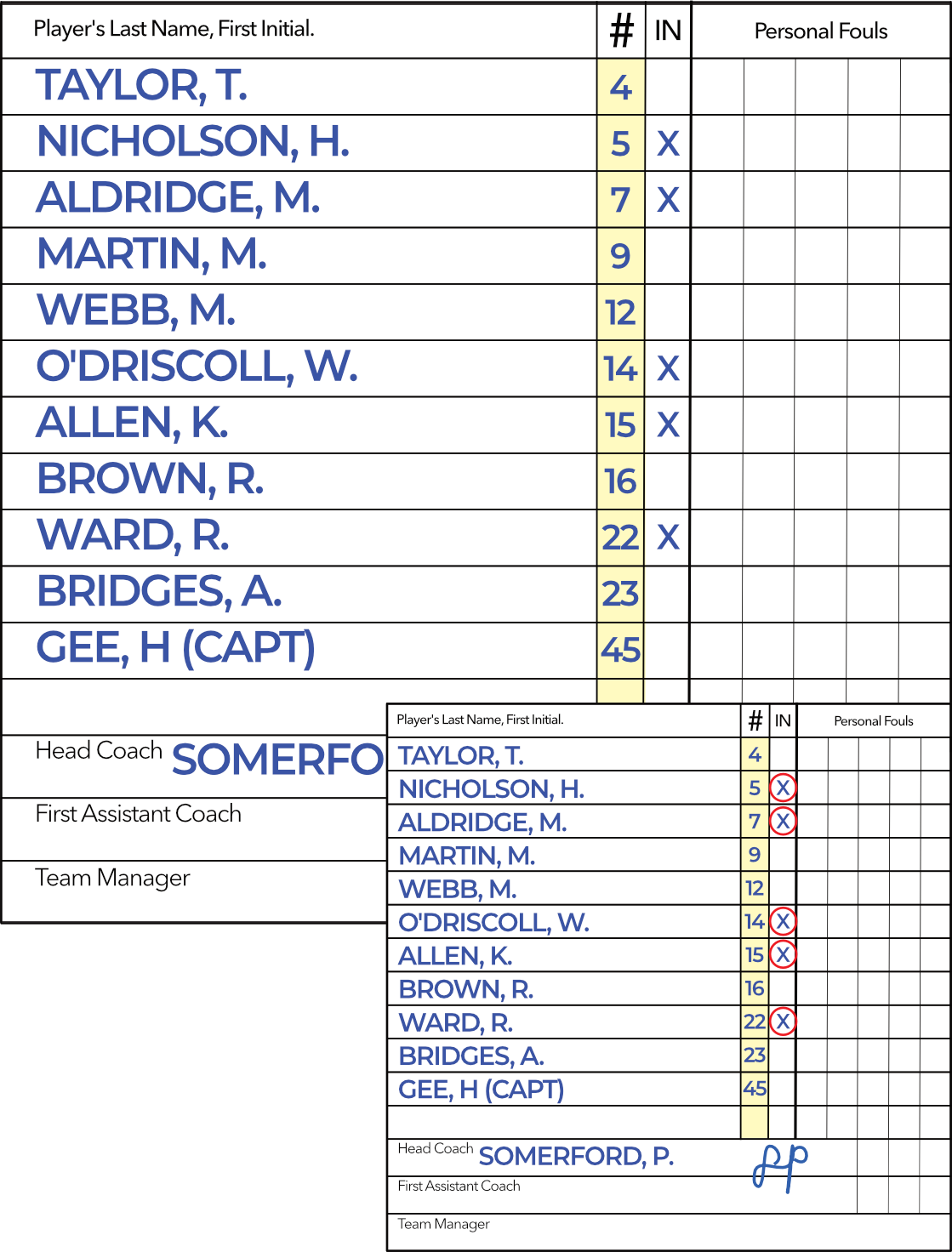
Fill in every section of the scoresheet header as well as the home and away team player squads; make sure you include their surname and first initial. As shown on the completed sheet, and the example to the right.
Players should be entered in numerical order, starting with the lowest number. 00, 0, 1, 2, 3 - 99.
All the writing should be done in capital letters so it is easier for others to read. In Start, add the time the game started, not the expected tip time (remember to add the finish time too!)
The coach and assistant coach also needs to be added written in the same manor as you would a player.
Once you have prepared the sheet, check with both coaches, home team first, get their starting five, mark this with an 'X'. The coach should add their starting 5 players. Get the coaches signature next to their name.
As the starting five are entering the playing court; circle the players in. Make sure you get the correct players to start the game. If there is a player, that isn't marked down as a starting player, speak to the referees.
Recording the Score
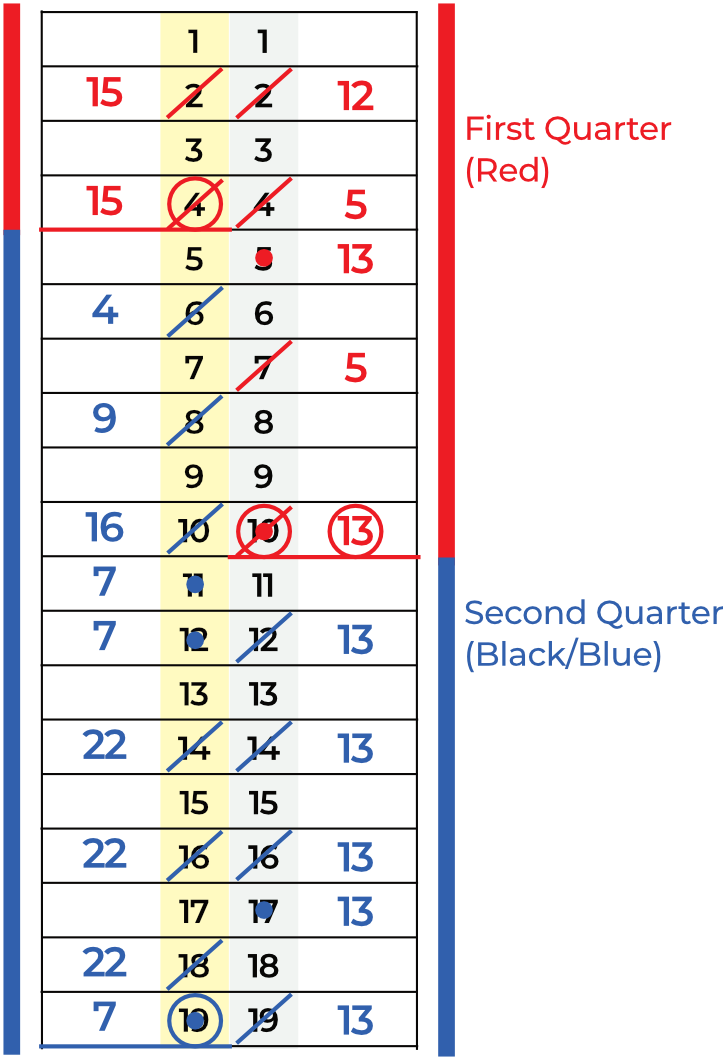
2 POINTS
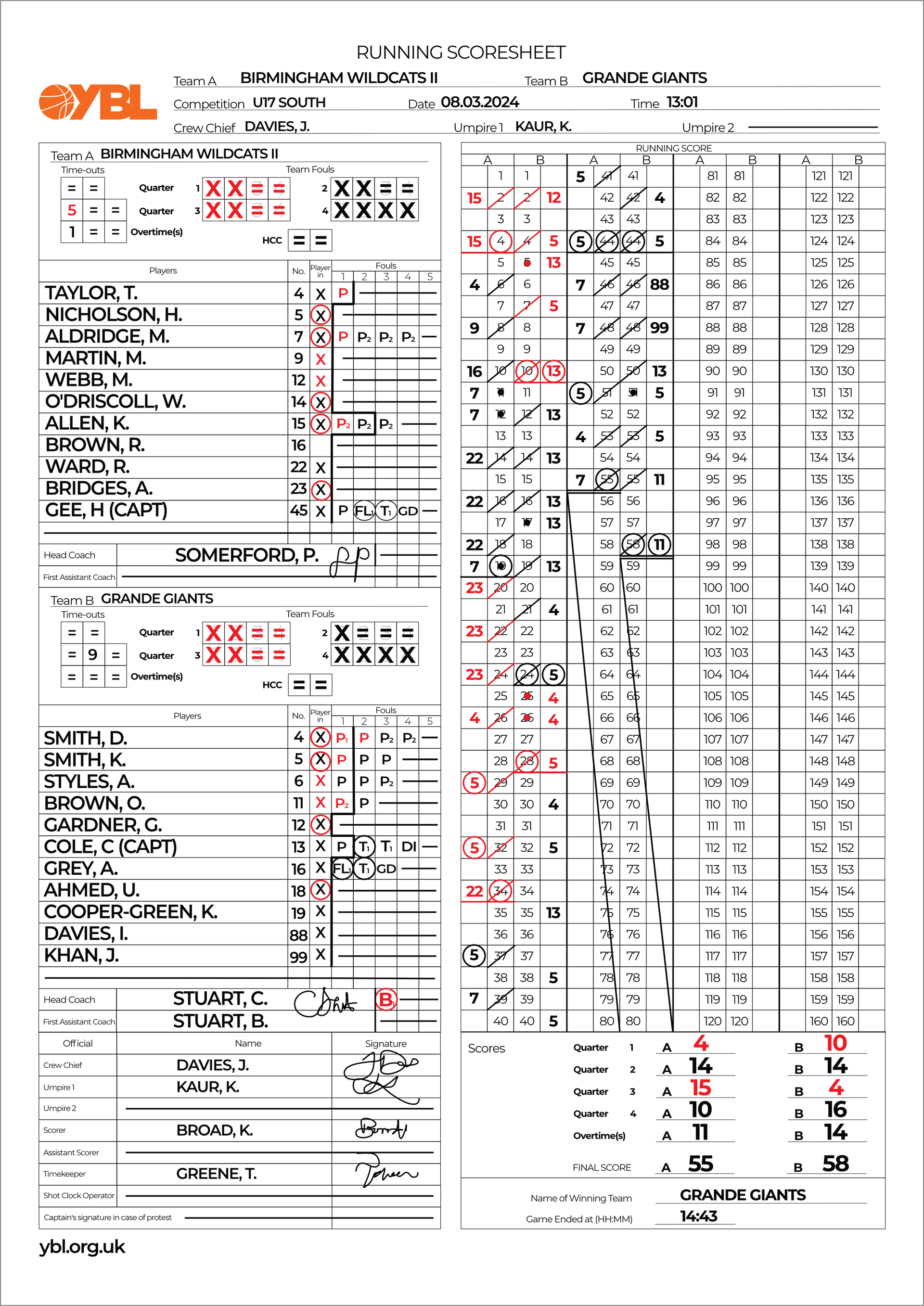
For recording two points use a diagonal line to go over the printed score. Write the player number next to that score.The diagonal lines need to be done the same throughout your scoresheet.
3 POINTS
For recording three points use a diagonal line to go over the printed score. Write the player number next to that score. Circle the player who scored.
The diagonal lines need to be the same throughout your scoresheet.
1 POINT (Free Throws)
For recording successful free-throws use a dot to go over the printed score. Write the player number next to that score
Ruling Off - End of the quarter, half time & end of the game
At the end of the quarter you need to complete your 'ruling out' with a ruler.
Draw a single line and circle the last score under the last basket scored for the first, second and third period and a double line to end the game. Circle the last score in every quarter.
Remember to 'rule-out' the team fouls for the first half with a solid line. That way you can see which fouls where recorded in each quarter.
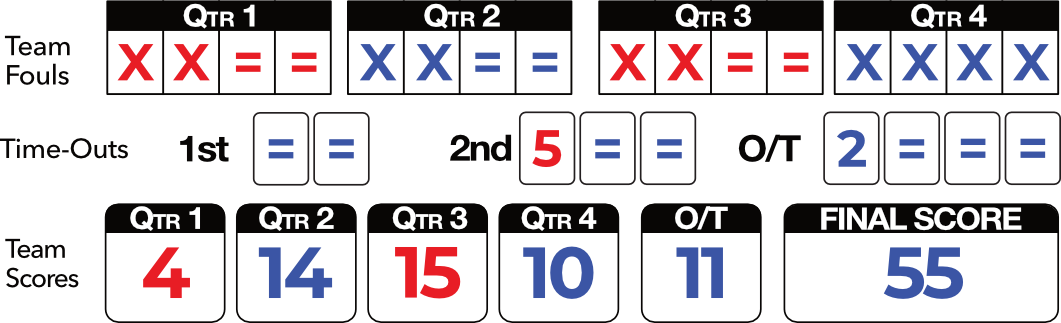
With the end of each period you are to record the period score. Marking down the points scored in each period. Not the overall score up to that point! Remember to put any overtime period scores in and the Final Score at the end of the game.
Rule out the column you finish in for each team.
Record the winning team name.
Unused player boxes - empty foul boxes
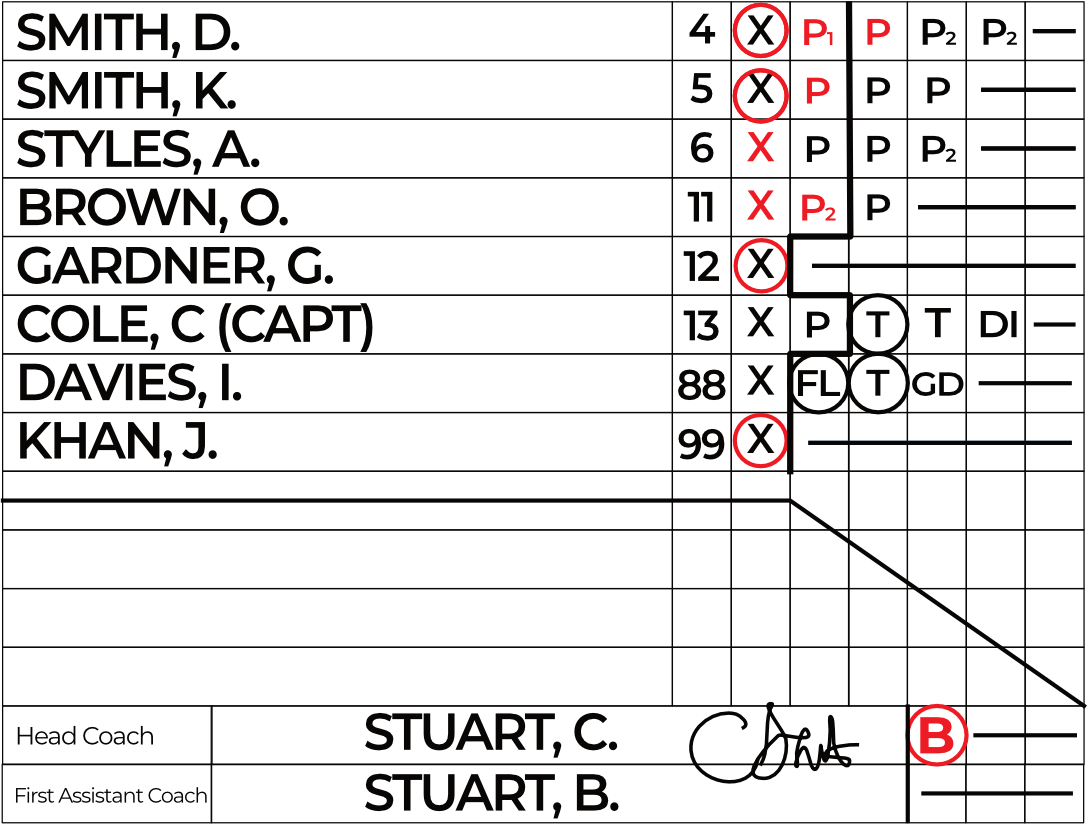
If a player hasn't played the game but was on the squad list, a line from player in box through the five personal fouls is to be drawn to show that the player has not taken part. If there are not 12 players the remaining unused lines are to be lined through.
Rule out any unused player boxes, as the game starts as shown.
Single empty player-box
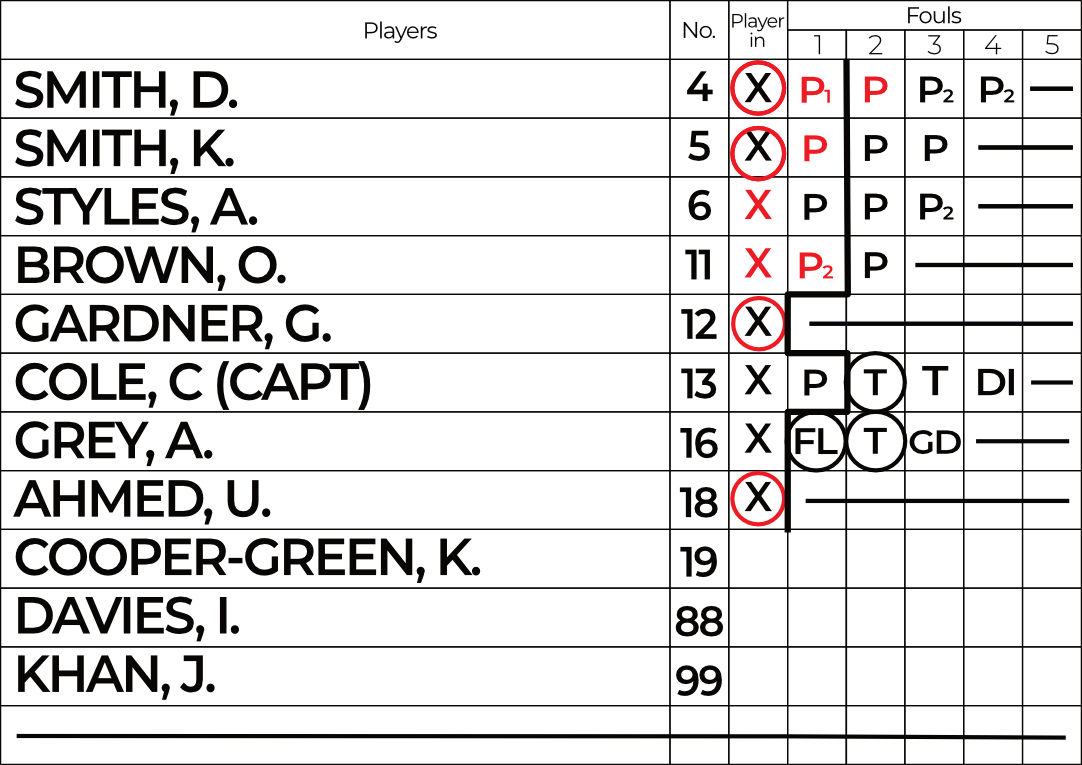
Multible empty player-box
Time-Outs
A team can take a time-out when the clock has been stopped by the referee or after a made basket when the team has been scored against.

Time-outs are recorded by entering the minute in which they are taken in each quarter.
Two are permitted in the first half, three in the second half.
Only two time-outs allowed to be taken in the last two minutes of the fourth period for each team. (Unused time-out)


Displaying 04:05 on the game clock. You record the time-out as the 6th minute.
4 + 6 = 10
Recording Fouls for all participants
Recording fouls towards a participant; player, coach and bench.
Personal fouls are recorded as a 'P' for Personal Foul for players on the court. THese are recorded next to the players name in order they are received.
The numbers following the 'P', are for any free-throws that are awarded to the opposing team as a result of the foul. A player can receive up to five personal fouls in one game.
Once a foul has been recorded next to a player, remember to record them as a team foul in the boxes above the players. This is an easy reference point to view team fouls in each quarter. If the game goes into overtime, the team fouls, if any, are carried over from Q4 as an extention.
Classification of Fouls
Any foul involoving free throws shall be entered with adding the corresponding number of free-throws (1, 2 or 3) beside the foul.
Those fouls that are circled will result being contributed to a persons game disqualification quota.
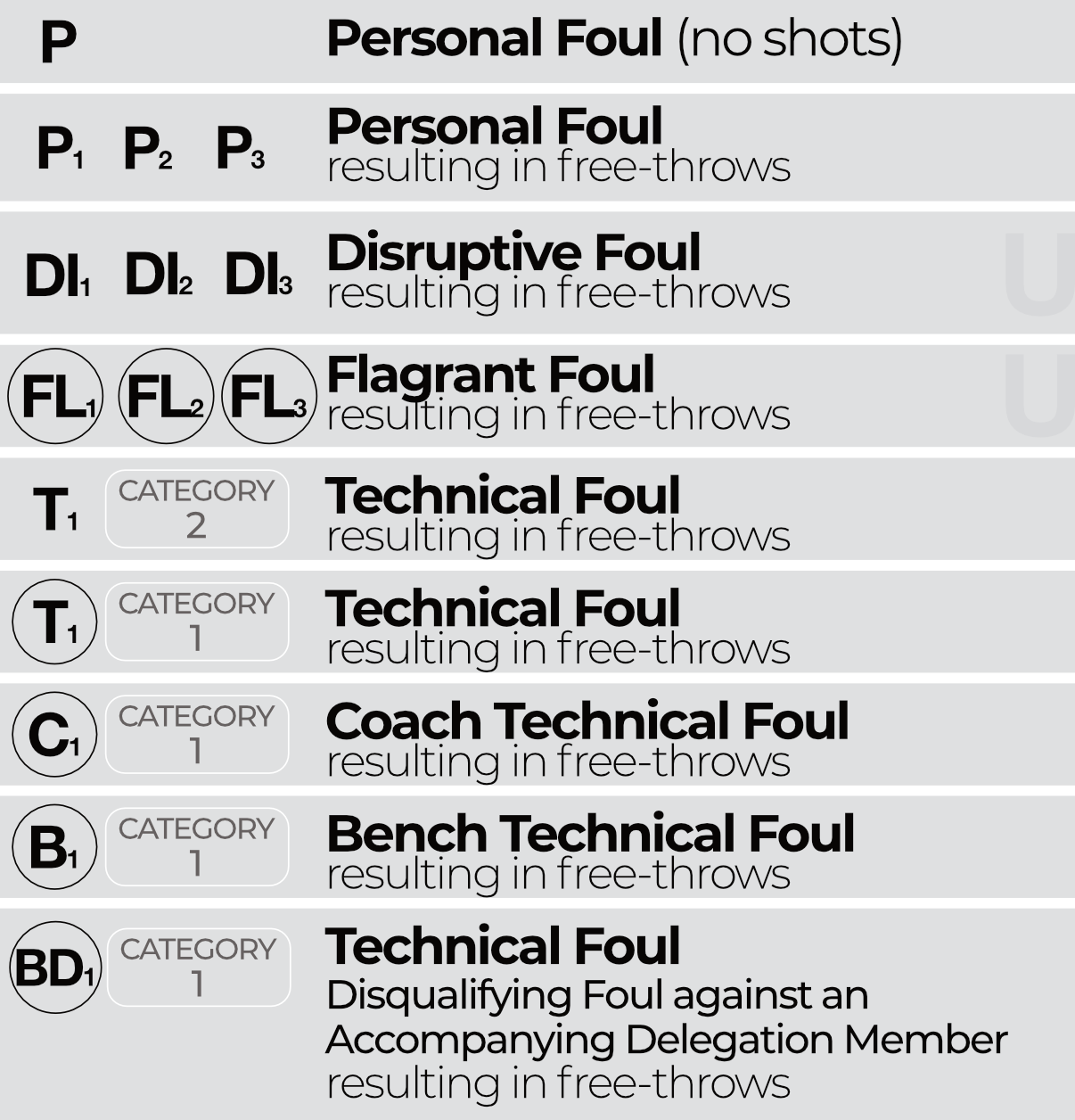
Game Disqualification Combinations

A player will be disqualified for the remainder of the game (GD) when charged with, 2 Category 1 Technical Fouls or 2 Flagrant Fouls (FL) or 1 Category 1 Technical Foul and 1 Flagrant Foul. These fouls, irrespective of the category, shall count towards team fouls.
Coach Disqualification Combinations
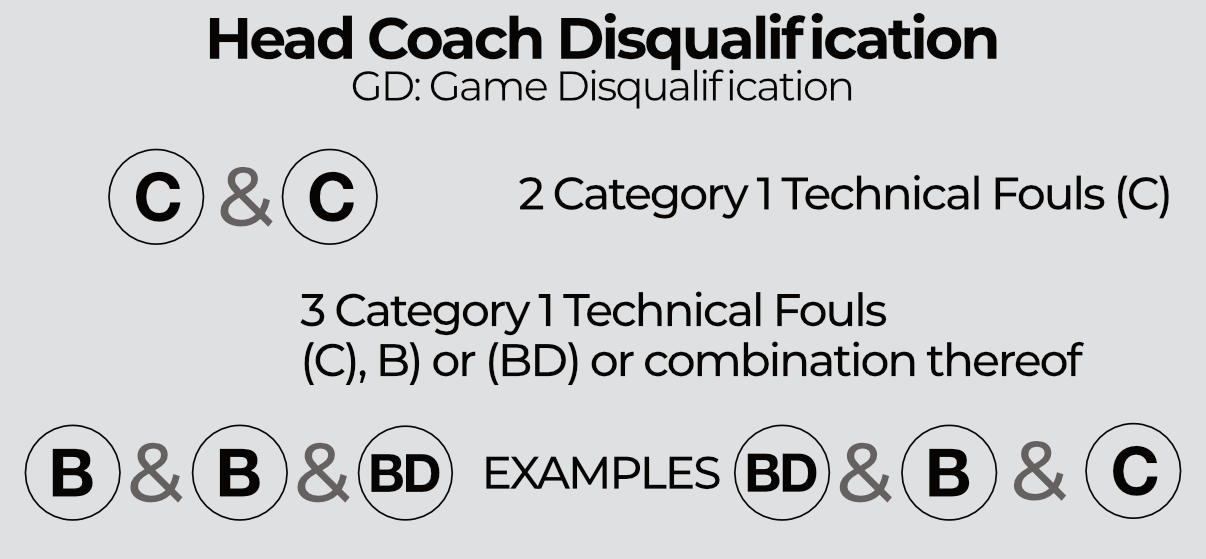
A coach will be disqualified for the remainder of the game (GD) when charged with, 2 Category 1 Technical Fouls (C) or a combination of up to 3 Category 1 Technical Fouls (C),(B) & (BD). These fouls, irrespective of the category, do not count as team fouls.
Disqualifications (recorded on the scoresheet)

A player, substitute, head coach or assistant coach that has been disqualified from the game shall have recorded a GD in the following box for being disqualified for a combination of fouls. Players do not need to leave the bench area.

A player, substitute, head coach or assistant coach that has been disqualified from the game for fighting shall have a 'F' in all remaining boxes. Individuals will need to leave the playing area.

A player, substitute, head coach or assistant coach that has been disqualified from the game - 'a straight DQ'. Individuals will need to leave the playing area.
Timekeeper Duties
When should you hear the game buzzer?
Before the Game and Q3

If not done automatically -
when the countdown clock is displaying 3:00 minutes, the TK shall buzz the scoreboard buzzer informing the floor officials how long is remaining.

If not done automatically -
when the countdown clock is displaying 1:30, the TK shall buzz the scoreboard buzzer informing the floor officials how long is remaining.
Before Q2, Q4 or O/T

If not done automatically -
when the countdown clock is displaying 0:30 seconds, the TK shall buzz the scoreboard buzzer informing the floor officials how long is remaining before the next quarter.

If not done automatically -
when the countdown clock during a time-out is displaying 0:10 or 0:50 the TK shall buzz the scoreboard buzzer informing the floor officials that there is ten seconds remaining during the time-out. You should signal '10' with your hands towards the centre of the court.
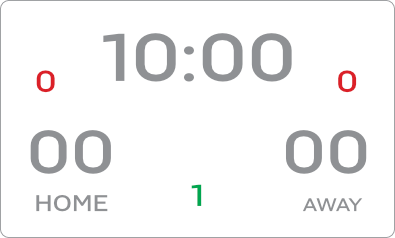
When should you stop the clock?
Upon hearing a whistle from the referee/seeing 'stop-clock' signals
Following a timeout request (before a made basket) stopping on a made basket for the opposing team.
After a made basket in the L2M (last two minutes) in the Q4 & O/T periods.
When should you start the clock?
On the first legal tip of the ball (Q1), when the referee lowers their arm and the ball touches a player on court.
When the referee lowers their hand on a inbound (sideline or baseline) ball.
After the last free-throw, after touching the ring, when legally touches a player. Or when a player touches the ball on court.
THE CLOCK DOES NOT STOP AFTER A BASKET
unless stated above
Example completed scoresheet